How long can a dog be left alone?
The quick answer is right below. After that: puppies, senior dogs, training, signs of stress and the case hardly anyone plans for.
Last reviewed:
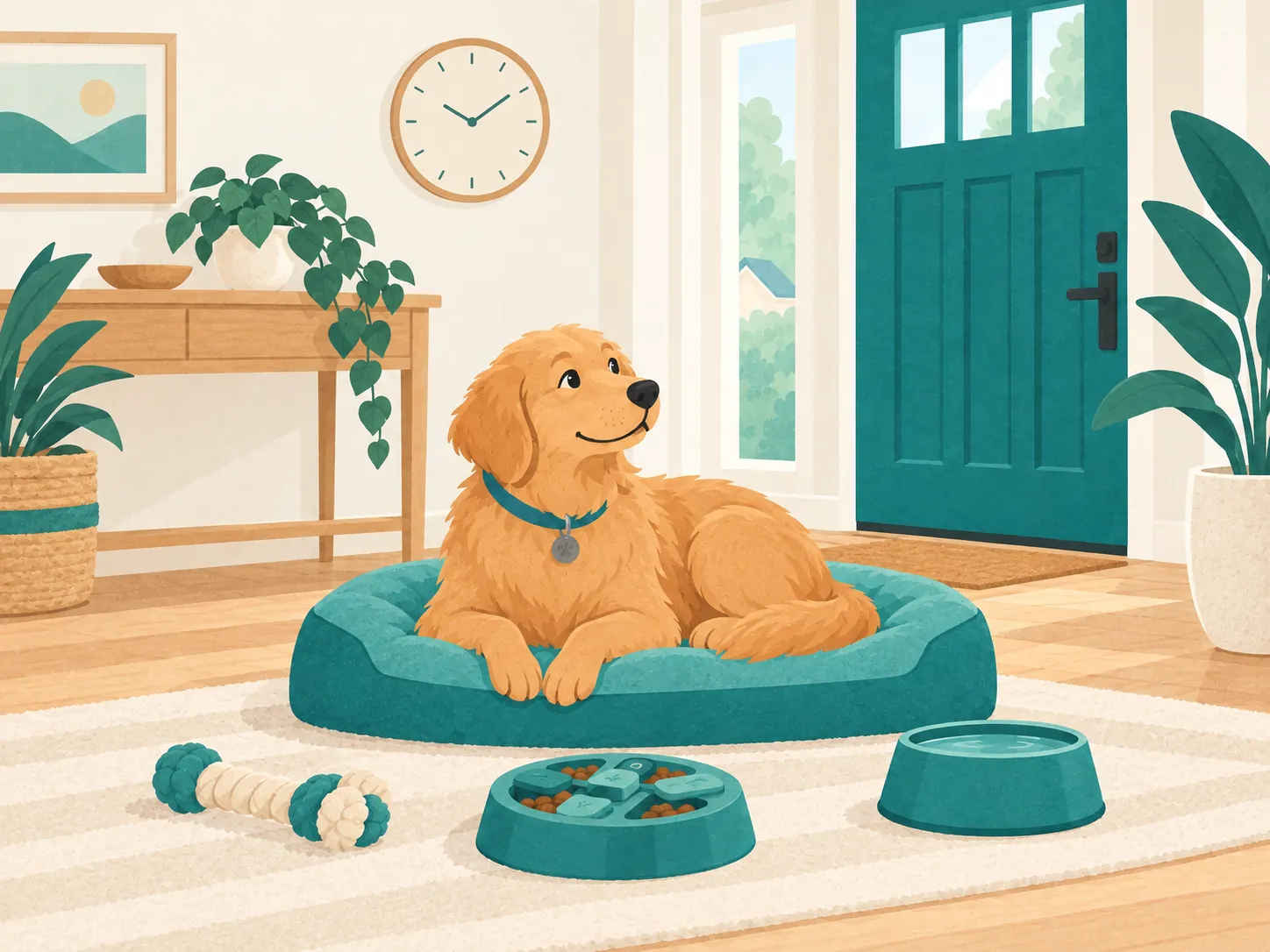
Quick answer
An adult dog should not be left alone for more than four hours at a stretch. That is the advice of Dogs Trust and the German animal welfare foundation VIER PFOTEN. The AKC puts the limit higher, at six to eight hours. Puppies manage far less.
| Dog | Guideline at a stretch |
|---|---|
| Puppy under 10 weeks | 1 hour (AKC) |
| Puppy, 10 to 12 weeks | 2 hours (AKC) |
| Puppy, 3 to 6 months | as many hours as months, so 3 to 6 (AKC) |
| Adult dog | 4 hours at most (Dogs Trust, VIER PFOTEN) |
| Senior dog | no fixed number in these sources, details below |
The sources disagree. The AKC bases its six to eight hours mainly on toilet breaks. Dogs Trust and VIER PFOTEN say four. Plan with the shorter number.
Puppies, adult dogs and senior dogs
Puppies
A young dog has to learn to be alone, and its bladder cannot hold for long yet. Treat the AKC figures above as a ceiling, not a target. Germany adds a duty for the owner: under the German Dog Welfare Ordinance, section 2, puppies up to 20 weeks old need at least four hours of contact with their keeper every day. That is time with you, not time alone.
Adult dogs
Four hours at a stretch is the guideline. The RSPCA says never to leave a dog alone long enough for it to become distressed. If your day is longer, Dogs Trust suggests someone calls in during the day or the dog goes to doggy day care.
Senior dogs
None of the sources above gives a fixed number for older dogs. Age, health and medication can shorten the time. Ask your vet how long your dog can manage, and plan one more break rather than one fewer.
Training your dog to be alone
A dog learns to be alone in small steps. Dogs Trust recommends this route:
- Give your dog a settled place, such as a bed or a den, and practise lying there calmly while you do something else.
- Practise being apart at home. A baby gate in a doorway lets your dog stay in one room while you are in the next.
- Offer a long-lasting chew or a food toy.
- Build up the time slowly, first inside the house, then outside it.
- Keep leaving and returning calm. No big goodbye, no big greeting.
A camera shows how your dog really spends the time (AKC).
Signs of stress
Dogs Trust lists panting, pacing, yawning when not tired, lip-licking, vocalising, urinating indoors and destructive behaviour.
If you see these signs, shorten the time alone and build up more slowly. For strong separation anxiety, ask an experienced trainer for help. Dogs Trust has an overview.
What to prepare before you leave
- Walk: Take a long walk first. Your dog can go to the toilet and will be tired (Dogs Trust).
- Water: Fresh water is always within reach (Dogs Trust).
- Occupation: A long-lasting chew or a food toy (Dogs Trust).
- Scent: An old piece of your clothing in the bed (Dogs Trust).
- Safe room: Put away cables, medication, cleaning products and toxic plants. Keep your dog in an area it knows.
- Temperature: The room should not heat up in summer or get cold in winter. Never leave a dog in a parked car.
And if you don't come back?
Every number above assumes you return. After an accident, in hospital or after fainting, nobody knows that a dog is waiting alone at home. After four hours, your dog is already at the limit. After that, every hour counts.
Three things solve this:
- Helpers with a key. At least one person who knows your dog and can get into your home. Two or three is better, so someone is always reachable.
- An emergency card in your wallet. If someone finds you, they know your dog is alone and whom to call. PawSafe creates the card as a PDF with up to four numbers in the order to call them. More: pet emergency card.
- PawSafe as the automatic safety net. You start the timer when your dog stays home alone. If you do not check back in, PawSafe alerts your helpers one after another. When one taps "I'll help", you find out right away and the others do not need to do anything. App notifications are free. SMS and WhatsApp come with an optional subscription.
How to arrange everything for a hospital stay is covered in What happens to my pet if I go to hospital?. If you have a cat: how long can you leave a cat alone.
Sources
Frequently asked questions about leaving a dog home alone
How long can a dog be left alone?
The guideline is four hours at most at a stretch, according to Dogs Trust and VIER PFOTEN. The AKC puts the limit for adult dogs at six to eight hours. Plan with the shorter number.
How long can a puppy be left alone?
The AKC says one hour under 10 weeks, two hours at 10 to 12 weeks, and after that about as many hours as the puppy is months old, up to six.
Can I leave my dog alone for eight hours?
That is above the four-hour guideline. Dogs Trust advises that someone calls in during the day or that the dog goes to doggy day care.
What are the signs that my dog is struggling when alone?
Dogs Trust lists panting, pacing, yawning when not tired, lip-licking, vocalising, urinating indoors and destructive behaviour. For strong separation anxiety, ask an experienced trainer.
How do I teach my dog to be alone?
Start at home: a settled place, short separations behind a baby gate, a long-lasting chew, then slowly more time. Keep leaving and returning calm.
Is there a law that limits how long a dog can be alone?
Not in Germany as a number of hours. The German Dog Welfare Ordinance, section 2 requires that a dog gets sufficient contact with its keeper several times a day. Puppies up to 20 weeks need at least four hours of contact per day.
Who takes care of my dog if something happens to me?
Only people who find out. Give at least one person a key, carry an emergency card and use PawSafe. If you do not check in when the timer runs out, PawSafe alerts your helpers one after another.